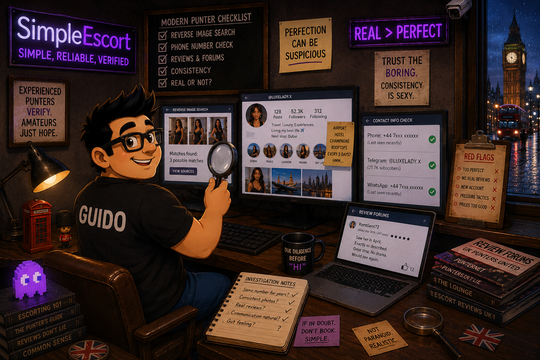


Spend enough time browsing British punting forums and you'll start to notice something rather curious. At first, you're there for the obvious reasons. You're looking for recommendations, trying to avoid obvious mistakes or simply satisfying your curiosity.
A few threads later, however, you realise you're reading detailed discussions about response times, parking, postcode accuracy and whether the photos were taken recently or sometime during David Cameron's premiership. Somewhere along the way, it becomes clear that British escort reviews aren't really about sex anymore. They've evolved into a peculiar form of consumer journalism. Nobody sits down intending to write like a professional reviewer.
It simply happens. One punter posts a thoughtful report, another adds a practical detail, someone else corrects a minor factual error and, before long, an entire community has quietly built a surprisingly reliable archive of collective knowledge. Change the subject matter and the structure feels remarkably familiar. Was the service delivered as advertised? Was communication clear? Did reality match expectations? Would you book again?
The experience matters. The details matter more.
The first surprise for newcomers is how little space experienced reviewers devote to what outsiders assume is the most important part of the encounter. Instead, they focus on everything surrounding the booking. Were the photos up to date? Did she reply promptly? Did the appointment start on time? Was the address easy to find? Did the advertised hour actually last an hour?
Read from the outside, it can sound faintly absurd. You begin to suspect that British punters are more willing to forgive questionable wallpaper than questionable organisation. Yet it makes perfect sense. The purpose of a review isn't to tell an exciting story. It's to reduce uncertainty for the next person. Every factual detail helps another reader decide whether a profile is genuine, whether the provider is reliable and whether the booking is likely to unfold exactly as expected. That's why even seemingly mundane observations become valuable.
Knowing that parking is difficult, the building is hard to find or mobile reception disappears inside the flat won't make the review more entertaining, but it will make it far more useful. And usefulness has always been one of Britain's favourite virtues. There's another reason practical details dominate. Chemistry can't be measured. One person's unforgettable experience may leave somebody else completely unmoved. Reliability, on the other hand, is much easier to evaluate. Either the photos reflected reality or they didn't. Either communication was clear or it wasn't. Either the booking happened as agreed or something went wrong. Facts leave far less room for interpretation than emotions ever will.
Trust is built through ordinary details
The best reviews are rarely the most dramatic. More often than not, they're the quiet ones. Everything matched the profile. Communication was straightforward. The appointment started on time. No unexpected surprises. In almost any other industry, that would make for painfully dull reading. In the escort world, it's exactly what people hope to find. Of course, nobody accepts every review at face value.
A glowing recommendation from a brand-new account attracts just as much suspicion as a furious complaint posted immediately after a disagreement. One review proves very little. Ten independent reviews all pointing in the same direction begin to paint a far more convincing picture. That's perhaps the most interesting feature of British punting culture. Experienced readers learn to look for patterns rather than exceptions.
They compare dates, notice recurring details, separate personal preference from objective problems and resist drawing conclusions from a single emotional account. In truth, it's no different from choosing a restaurant, a hotel or a tradesperson. Trust comes from consistency, not isolated opinions. Viewed from the outside, this almost forensic attention to detail can seem slightly obsessive.
Grown men debating response times on WhatsApp or whether a set of photographs is six months old instead of two doesn't immediately sound like gripping conversation. Yet that's precisely what makes the community valuable. The reviews aren't trying to entertain anyone. They're trying to leave the next stranger a little better informed than the last one.
It's an unmistakably British approach to trust: not grand promises or dramatic declarations, but dozens of small, apparently ordinary details that gradually add up to something genuinely credible.