
Dublin is a proper city right up until you need it to provide a little anonymity. Then it suddenly starts feeling like a large village with better hotels. Anyone who has lived here long enough knows the problem. You walk into a pub on the other side of town and somehow meet your sister's old flatmate. The bloke beside you at a match turns out to work with someone from your office.
You spend twenty minutes crossing Dublin to get away from your usual crowd and discover one of them has apparently had exactly the same idea. For punters, this creates a peculiar kind of nervousness. Booking an escort in a city of more than a million people should offer reasonable odds of going unnoticed, yet the first-timer can still find himself sitting in the car wondering whether somebody from accounts has chosen this exact street for an evening walk.
Experienced Dublin punters eventually learn something useful: the city is rarely watching as closely as you think. Most people have their own lives to worry about. The difficulty is convincing yourself of that when you're the one hoping not to bump into anybody.
Nobody at the Hotel Cares as Much as You Do
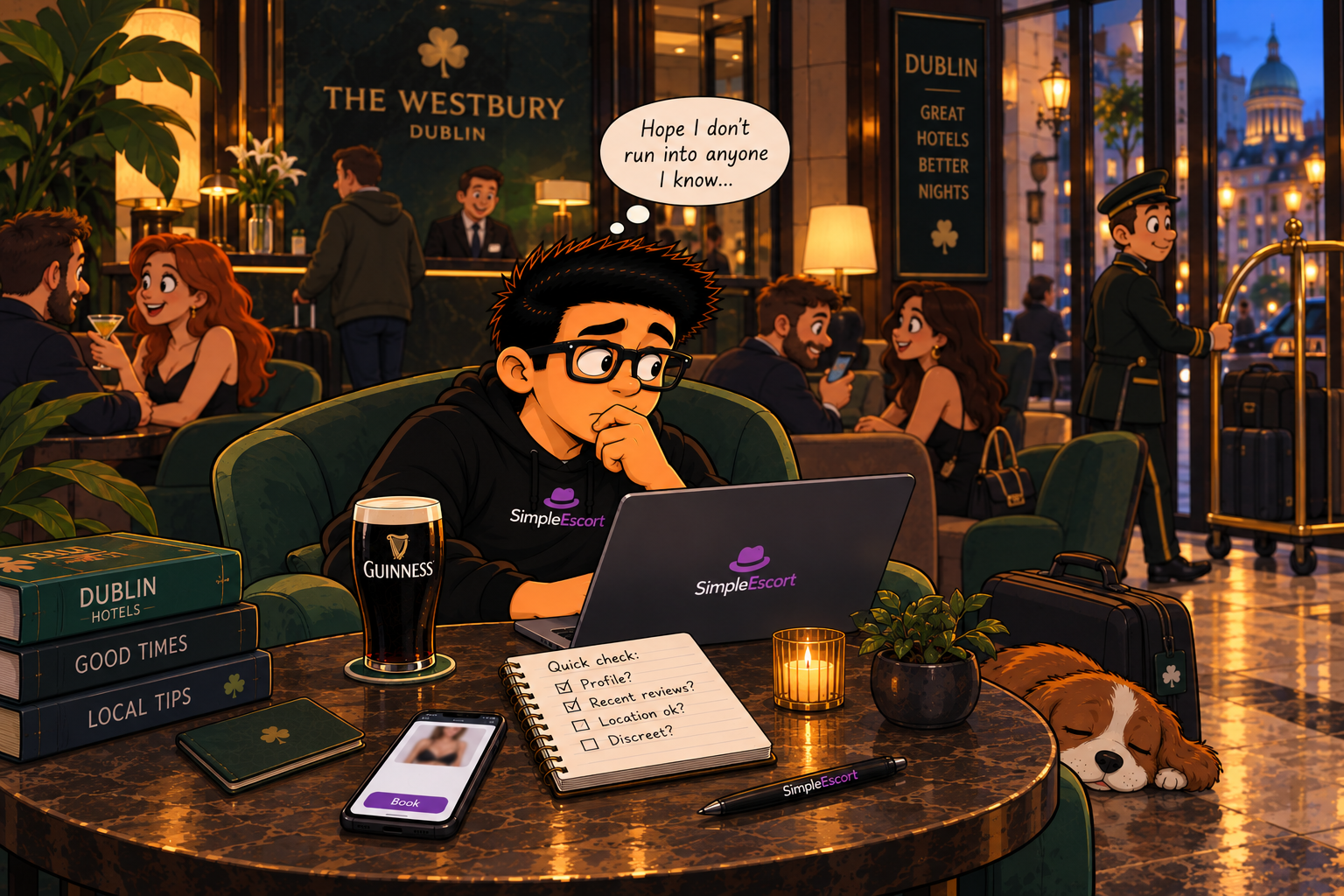
Hotels are particularly good at turning otherwise sensible men into amateur surveillance officers. A normal guest walks through reception, checks the lift and gets on with his evening. A nervous punter notices everything. The couple by the bar. The receptionist looking vaguely in his direction.
The man waiting for a taxi who looks disturbingly similar to someone from work, although after three inspections he probably isn't. Suddenly crossing a lobby requires the situational awareness of a diplomatic extraction. This is usually where trying to be discreet starts making someone much more noticeable. Looking over your shoulder, repeatedly checking your phone or standing outside for ten minutes waiting for the perfect moment doesn't make you invisible.
It makes you look like a man who has forgotten how buildings work. Regular punters tend to be less theatrical because experience has taught them that hotels see hundreds of people coming and going. Staff generally aren't assembling dossiers on who took which lift at 8.40 on a Thursday evening.
Even if you do recognise someone, there's another useful fact worth remembering: they're in the same hotel too. Dublin paranoia has a wonderful ability to assume everyone else possesses both perfect eyesight and absolutely no secrets of their own.
The Best Discretion Usually Looks Like Nothing
The same principle applies before the booking even begins. First-timers can spend longer checking profiles, reviews and locations than they will eventually spend travelling across Dublin. Is the profile genuine? Are the reviews recent? Is that apartment really where it says it is? Could someone recognise the car? Perhaps another look at the reviews would help, despite nothing having changed since the previous four. Some caution makes sense.
Irish punters have good reasons to care about privacy and to establish that a profile looks genuine before making contact. But there is a point where useful checking turns into a private detective agency staffed by one increasingly nervous man. Experienced punters usually become calmer rather than more careless. They learn what information matters, keep communication straightforward and don't involve half their social circle in something they're supposedly trying to keep private. Most importantly, they stop treating discretion as an elaborate performance.
Dublin is large enough for people to mind their own business and small enough that occasionally you'll still see somebody you know. There is no clever system that changes that. Behave normally, respect everybody else's privacy and remember that the stranger across the lobby probably isn't wondering what you're doing there.
And if he is, there's always a reasonable chance he's hoping you won't ask him the same question.